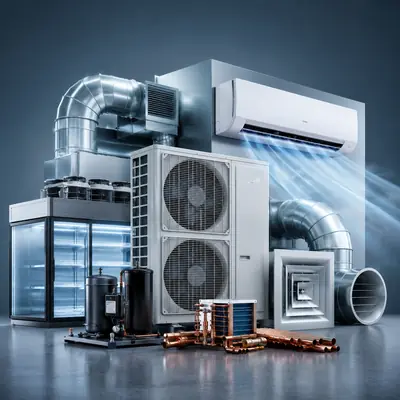
Ask an experienced engineer for the most common fault they see on air-conditioning installations, and the answer is rarely a defective unit. It is a system that was sized by rule of thumb, chosen by habit, and installed at a capacity the space never actually needed. Getting the sizing right — and matching it to the correct system type — is the single decision that most determines whether an installation performs well for its whole life.
Estimate the load, do not guess it
A cooling or heating load is the rate at which a space gains or loses heat under design conditions, and it depends on far more than floor area. A proper estimate accounts for:
- Room use — an office, a server room and a restaurant of identical size have very different loads.
- Glazing — the area, orientation and shading of windows, often the largest single gain in a modern façade.
- Occupancy and equipment — people, lighting, computers and appliances all add sensible and latent heat.
- Orientation and exposure — a west-facing room peaks in the afternoon; a north-facing one behaves quite differently.
- Fabric and insulation — wall, roof and floor construction, and how airtight the envelope is.
The "so many watts per square metre" shortcut ignores all of this. It is useful only as a sanity check against a real calculation, never as a substitute for one.
Match the system type to the building
Capacity is only half the decision; the topology matters just as much. The main families each suit a different pattern of use:
- Single split — one outdoor unit to one indoor unit. Simple, efficient and cost-effective for a single room or a small standalone space.
- Multi-split — several indoor units on one outdoor unit. Suited to apartments and small offices where a handful of rooms need independent control without multiple condensers on the façade.
- VRF — variable refrigerant flow serving many indoor units from a common system, with precise modulation. The natural choice for larger commercial buildings, hotels and mixed-use floors.
- VRF with heat recovery — moves heat from zones that need cooling to zones that need heating simultaneously, ideal for deep-plan buildings with a warm core and cool perimeter, or mixed occupancies running at once.
The real cost of oversizing
Because undersizing is embarrassing on a hot day, the instinct is to add a margin "to be safe." Oversizing, however, carries costs that are easy to miss:
- Short-cycling — an oversized unit satisfies the thermostat quickly, then shuts off, then restarts. The frequent stop-start stresses the compressor and wastes energy on each start.
- Poor dehumidification — a unit that runs in short bursts never runs long enough to wring moisture from the air, leaving a space that is cold but clammy.
- Part-load inefficiency — equipment is most efficient near its design point; a system that spends its life lightly loaded rarely reaches that point.
- Higher capital cost — the larger unit, heavier pipework and bigger electrical provision are all paid for up front, for capacity that is never used.
Why part-load performance matters more than peak
A system meets its design peak load for only a handful of hours a year. For the overwhelming majority of its operating life it runs at part load — a fraction of full capacity. This is why inverter-driven equipment, which modulates smoothly down to low output, so consistently outperforms fixed-speed units in practice: it spends its life in the operating range that actually matters. When comparing candidates, weigh how each behaves at 25, 50 and 75 percent of capacity at least as heavily as its headline rating.
Correct sizing is where a good installation begins. For equipment across single split, multi-split and VRF from authorised brands, see our HVAC-R sector page, and when you are ready to move from concept to a specified system, request a quotation and our technical team will help match capacity to the load.
This article is published for engineers and specifiers. For project-specific advice, contact our technical sales team at sales@eram-group.net.