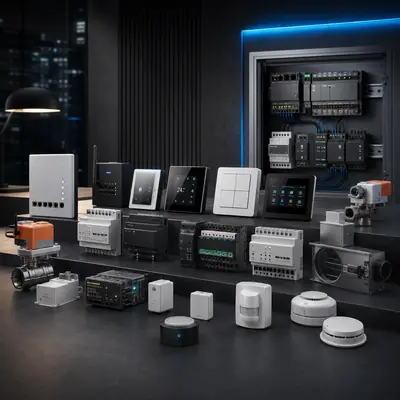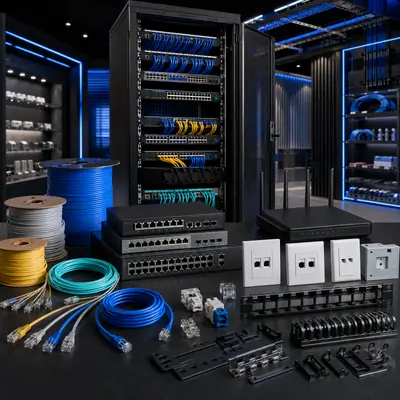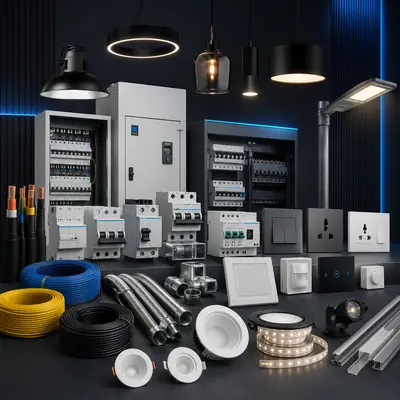
A modern commercial or institutional building is increasingly defined less by its mechanical plant than by the layer of intelligence that coordinates it. Building automation brings heating and cooling, ventilation, lighting, metering and safety systems onto a shared control fabric, so that equipment which once ran in isolation now exchanges data and acts on it. The result is a building that regulates itself against real conditions rather than fixed schedules.
What a building management system does
A building management system (BMS) is the supervisory layer that sits above individual pieces of equipment. It connects the controllers on chillers, air-handling units, heat pumps, lighting circuits, energy meters and the interfaces to fire and access systems, and presents them to a facility team through a single interface. From there, operators schedule plant, monitor live values, receive alarms and adjust setpoints across the whole estate.
Underneath the supervisory layer sit field controllers — the programmable devices that run each system locally and keep doing so even if the network is interrupted. Good automation design keeps this distinction clear: local control for reliability, supervisory control for coordination and insight.
Sensors and connectivity
Automation is only as good as the data it acts on. Sensors for temperature, humidity, CO₂, occupancy, pressure and power feed the controllers with a continuous picture of how the building is performing and how it is being used. Open communication protocols — BACnet, Modbus and KNX among them — let devices from different manufacturers share that data on a common network instead of remaining locked in separate silos.
That connectivity is what turns a collection of controlled systems into a connected building. Lighting can respond to daylight and occupancy; ventilation can track CO₂ rather than run flat out; and metering can attribute consumption to the systems that drive it.
The controls that tie it together
Interoperable controls are the components that make integration practical, and ERAM carries several of the established names in the field — among them Carel, Honeywell and Siemens. Carel is widely used for HVAC and refrigeration control and humidity management; Honeywell and Siemens supply BMS controllers, field devices, actuators and valves that speak the standard protocols. Specifying compatible controls from the outset avoids the integration gaps that appear when systems are chosen in isolation.
What owners and facility teams gain
The practical benefits fall into four areas:
- Efficiency — plant runs to actual demand, and waste from equipment left running or fighting itself is designed out.
- Comfort — temperature, air quality and lighting are held to consistent conditions across occupied spaces.
- Uptime — alarms and trends surface faults early, so problems are addressed before they become failures.
- Data — metered, trended information gives owners an evidence base for energy decisions and maintenance planning.
New build and retrofit
Automation is not only for new construction. Much of the region's building stock was completed before integrated controls were common, and a well-planned BMS upgrade — new sensors, modern controllers and a supervisory front end laid over existing plant — can deliver most of the benefit without replacing the underlying equipment. The scope is chosen to match the building: a phased retrofit that targets the systems with the largest energy and comfort impact first, then extends as budget allows. Because open protocols let old and new devices coexist on the same network, an estate can be modernised in stages rather than in a single disruptive project.
ERAM supplies the controls and connected-building components behind these systems across the region. Explore the building automation sector, or see how the pieces come together in building management and controls.